
Can exercise improve body image with PCOS?
16 weeks of aerobic training eased body dissatisfaction, but not how women judged their own size
A 16-week three-arm controlled trial in women with PCOS: aerobic training eased body dissatisfaction, anxiety, depression, and sexual function, while body size perception, weight, and BMI stayed unchanged.
In this story
Women with PCOS in Brazil spent 16 weeks in one of three groups: continuous aerobic training, intermittent aerobic training, or no exercise. The researchers measured body image two different ways, and got two different answers. On the questionnaire that captures how much distress and preoccupation you carry about your body, the exercise groups improved and the no-exercise group didn't budge. On the silhouette scale that measures how accurately you estimate your own size, nothing changed for anyone. Anxiety, depression, and sexual function scores all improved with exercise too. And here's the part worth holding onto: weight and BMI stayed essentially flat the whole time. The good news arrived without the bodies changing at all.
The numbers that matter
Can we actually trust this?
Yes. This is a real controlled trial: 110 women randomly assigned by an external source to three arms, including a no-exercise comparison group, which a surprising amount of exercise research skips. It was registered with both the Brazilian and international trial registries, cleared by the university hospital's review board, funded by Brazil's public research bodies, and the authors declare no conflicts. The questionnaires are validated Portuguese-language versions of well-established instruments. This is careful work by a group that has been studying exercise and PCOS for years.
A few things to hold lightly, though. Body image wasn't the question the original trial was designed around, so this is a follow-on analysis of an existing dataset. Everything measured here is self-reported, and the women knew which group they were in, so some of the improvement could be expectation rather than effect. The control group did nothing at all rather than a placebo activity like stretching, which leaves regular contact with researchers as an alternative explanation. About one in five participants didn't finish or didn't follow the protocol. And when you read the results closely rather than the abstract, only the continuous training group clearly outperformed the no-exercise group on body dissatisfaction; the intermittent group improved compared to where it started, which is a softer claim. None of this sinks the finding. It just means we're looking at encouraging evidence rather than a closed case.
Does this apply to you?
This study is most relevant if:
- You have PCOS diagnosed by Rotterdam criteria and are between 18 and 39
- You're not currently exercising regularly (women training three or more times a week were excluded)
- Your relationship with your body, not just your symptoms, is part of what makes PCOS hard
- You're at a BMI in the high-20s range, which is roughly where this group sat on average
One thing to know about the sample: these women were recruited from a hospital gynecology and infertility clinic, so they were already in specialist care. That's a more medicalized starting point than most readers are coming from.
Why this matters
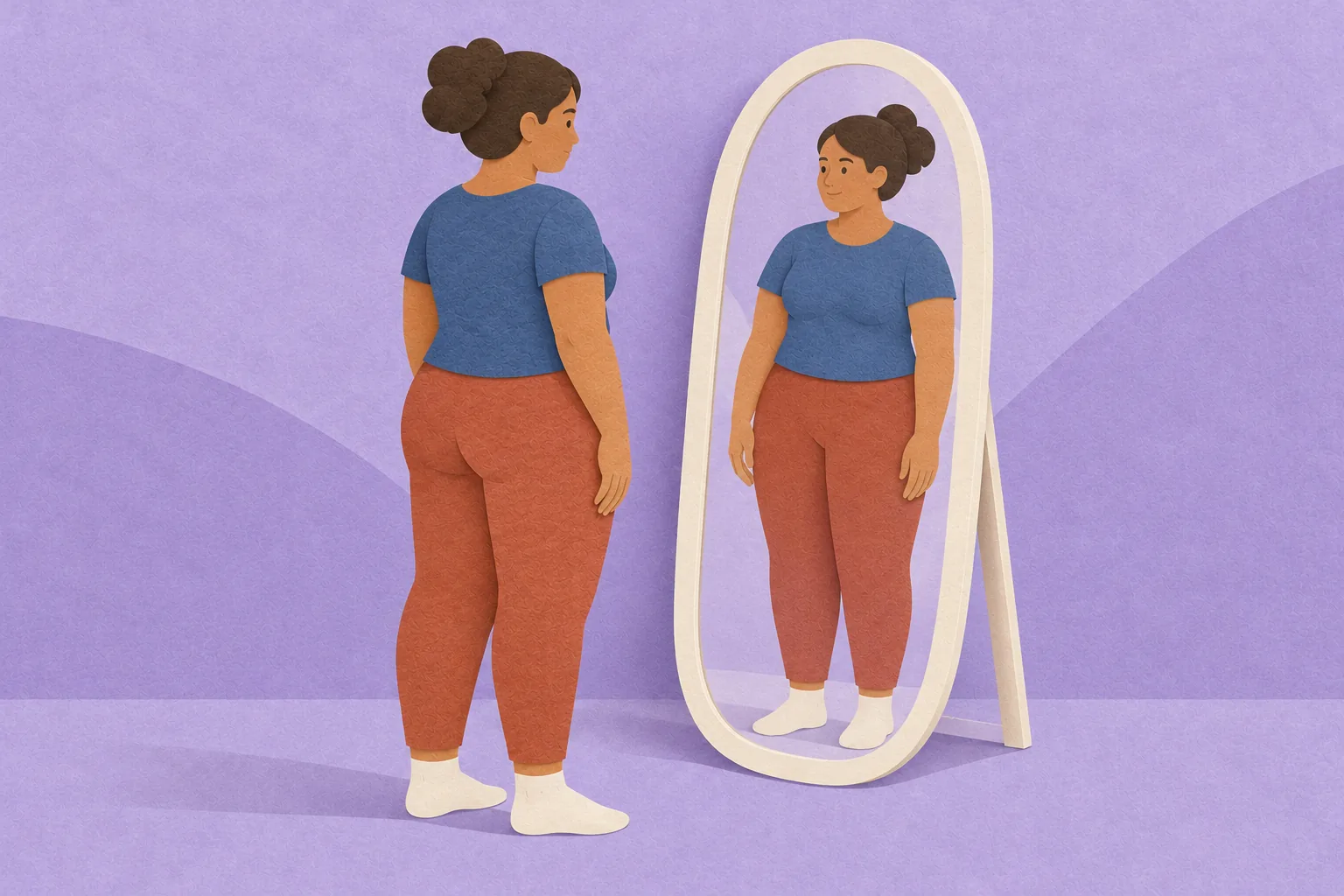
Body image isn't one thing, and this study shows you why that's worth knowing. The researchers measured two separate dimensions: how women felt about their bodies, all the preoccupation and self-criticism and mental noise, and how accurately women saw their bodies compared to their actual size. Exercise moved the first one. It left the second one alone.
Take the honest half first. Sixteen weeks of training didn't make anyone better at judging their own size, and the researchers have a reasonable explanation for that: perception of size tracks pretty closely with the body itself, and these bodies didn't change. Fair enough. It's a real limit, and it's useful to know so you're not disappointed when a workout habit doesn't rearrange what you see in the mirror.
But the half that did move is the half that runs your day. Body dissatisfaction dropped by around 13 points on average in the continuous group, from a score in the moderate-concern range down toward mild. That's not a rounding error. That's the difference between your body being a constant background hum of worry and being something you think about less. And it happened while weight and BMI sat still, which means the relief wasn't a reward for shrinking. It arrived on its own terms.
So much PCOS advice runs on the premise that you'll feel better about your body once your body changes. This study politely disagrees. The feeling moved first, without waiting.
If you want to try this
- Continuous training means one steady effort, start to finish.
You pick a moderate pace you can hold, and you hold it for the whole session, no surges and no rests. It's the classic version of cardio: a long walk, a steady jog, an unbroken stretch on a bike. This is the group with the strongest body image result in this study.
- Intermittent training means alternating harder and easier stretches.
You push, you ease off, you push again, repeating through the session. It's the same total workout broken into a rhythm rather than one flat line. In this study, it did about as well as continuous training on mood and sexual function, and slightly less well on body image.
- Give it a full 16 weeks before you judge it.
Measurements were taken at the beginning and at the end, with nothing in between. There's no reason to expect this kind of shift to show up in a fortnight, so a slow start isn't a failure.
- Don't wait for the scale to give you permission to keep going.
Weight and BMI were flat in both exercise groups across the entire study, and the no-exercise group's waist measurement actually crept up. The psychological gains were completely independent of any of that.
- Be gentle with what you expect it to fix.
If you're hoping to spend less of your day thinking about your body, this study suggests exercise genuinely helps. If anxiety or low mood are weighing on you heavily, those improved here too, but that's a conversation worth having with a clinician alongside anything you do on your own.
FAQ
- Does exercise improve body image in women with PCOS?
- Partly. In this 16-week trial, women in both aerobic training groups reported less distress and preoccupation about their body shape, while the no-exercise group didn't change. But the exercise made no difference to how accurately women estimated their own body size. Only the continuous training group clearly outperformed the no-exercise group, so the intermittent result is weaker.
- Can body image improve without losing weight?
- That's what happened here. Body weight and BMI stayed essentially flat in both exercise groups across all 16 weeks, and body dissatisfaction scores still dropped by roughly 13 points on average in the continuous training group. The improvement did not run through weight loss.
- Does PCOS affect anxiety, depression, and sexual function?
- This study found all three tangled together. Women who scored higher on body dissatisfaction also scored higher on anxiety and depression, and higher anxiety and depression scores went with lower sexual function scores. Both exercise groups improved on all of these over 16 weeks while the no-exercise group didn't, though these were self-reported scores in an unblinded trial.
- Is continuous or intermittent exercise better for PCOS?
- This study can't settle it. The two exercise formats weren't significantly different from each other on anything measured, and the authors suggest continuous training may have a slight edge for body image. That sits awkwardly next to the trial covered in Issue 25, which found intervals better for anxiety. Two small studies pointing different directions usually means the honest answer is that we don't know yet.
How Sachi can help
The pattern in this study is one you'd never catch on your own without writing it down. Sixteen weeks of exercise, no change on the scale, and a real shift in how much mental space your body was taking up. Sachi is built to make exactly that visible: your exercise flows in from Apple Health so the sessions log themselves, and alongside it you're tracking mood and the symptoms that actually shape your day. When neither your weight nor your mirror is going to tell you whether something is working, you need a record of how you've been feeling to answer the question.
That's the bigger reason we build from studies like this one rather than from advice. This trial separated two things that usually get collapsed together, feeling about your body and seeing your body, and found that an intervention touched one and not the other. Precision like that is what makes research useful, and it's what a tracking tool can give you about your own life. Some of this is live today and some is still being built. You can follow along or join the beta at sachi-health.com.
Study at a glance
Reference
Kogure GS, Lopes IP, Ribeiro VB, Mendes MC, Kodato S, Furtado CLM, Silva de Sá MF, Ferriani RA, Lara LAS, dos Reis RM (2020). The effects of aerobic physical exercises on body image among women with polycystic ovary syndrome. Journal of Affective Disorders , 262, 350-358. https://doi.org/10.1016/j.jad.2019.11.025
Cite this issue
Sachi Health. (August 11, 2026). Can exercise improve body image with PCOS? 16 weeks of aerobic training eased body dissatisfaction, but not how women judged their own size. The PCOS Brief. https://www.sachi-health.com/blog/the-pcos-brief-issue-26
Further reading from The PCOS Brief
Patten RK, McIlvenna LC, Moreno-Asso A, Hiam D, Stepto NK, Rosenbaum S, Parker AG (2023). Efficacy of high-intensity interval training for improving mental health and health-related quality of life in women with polycystic ovary syndrome. Scientific Reports, 13, 3025. https://doi.org/10.1038/s41598-023-29503-1 — Read our plain-English summary.
Lopes IP, Ribeiro VB, Reis RM, Silva RC, de Souza HCD, Kogure GS, Ferriani RA, Lara LAS (2018). Comparison of the effect of intermittent and continuous aerobic physical training on sexual function of women with polycystic ovary syndrome: randomized controlled trial. The Journal of Sexual Medicine, 15(11), 1609-1619. https://doi.org/10.1016/j.jsxm.2018.09.002 — Read our plain-English summary.
Thomson RL, Buckley JD, Brinkworth GD (2016). Perceived exercise barriers are reduced and benefits are improved with lifestyle modification in overweight and obese women with polycystic ovary syndrome: a randomised controlled trial. BMC Women's Health, 16, 14. https://doi.org/10.1186/s12905-016-0292-8 — Read our plain-English summary.
Tarkesh F, Namavar Jahromi B, Hejazi N, Hoseini G (2022). Effect of vitamin K2 administration on depression status in patients with polycystic ovary syndrome: a randomized clinical trial. BMC Women's Health, 22, 315. https://doi.org/10.1186/s12905-022-01825-8 — Read our plain-English summary.